Welcome Critters!

Welcome and thank you for your interest in providing me with critiques from Critters.org.

The chapter posts are  password protected to prevent “first publication” disputes and to limit access to the manuscript. To obtain the password, please fill out the form below and I will email you the password.

Please use the same email that you have registered for Critters.org so that I can award points after you have finished critiquing.

← Back

Thank you for your response. ✨

NOTE: I will never use your email for anything other than communicating about your critiques or my novel.

Please also read the Welcome and Ground Rules to review the type of critique I am after. Critiques should be left as comments appended to the chapter posts.

Here is the link to Chapter 1 so you don’t have to hunt through the archives.

NaNoWriMo is DONE! And so am I!

The month of November is nearly over. Out there in the world, 300,000 people rush to finish. But I am not one of them.

Because I finished last night!
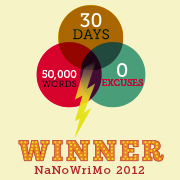
NaNoWriMo Winner

Inline image 1

National Novel Writing Month (NaNoWriMo) will officially end at midnight tonight, but amazingly, at 50,703 words, I validated my novel last night at 11:30pm. That’s new words – the book is about double that, but I wanted validation of my efforts this month. I honestly cannot believe that I did it. Eyes feel slightly crossed and everything has a muzzy sensation, mostly I think due to the hours spent in front of a screen and the lack of sleep. But it’s done!

What does that mean for you, my fair alpha readers?

It means that my basic, very, VERY rough draft is done. It also means that now, instead of working on new words, I can focus on revising and posting what I’ve done. And THAT means chapters will be coming fast and furious. My goal is to have revised and posted all chapters, the whole book, by Christmas Eve.

I’m calling it Alpha December; 25 days of non-stop revising and posting for your holiday reading pleasure.  Based on the fact that Chap. 11 is already up, that should translate into a chapter every two days to meet my deadline.

Sleep deprived? I can manage another month.

If you haven’t yet had a chance to start reading, I still very much look forward to your feedback and hope you will have time to read.

If you have started, but haven’t taken time to comment, please do so. Even an “I liked it” is helpful if you don’t know what else to say.

For those who have been steadily slogging along, reading and commenting as I post, I thank you. I hope you are enjoying it. And I hope I make your holidays a little more fun with a new story. Thank you for your patience.

And to any others out there who have had a story percolating in the back of their minds, I challenge you to start. Get it down on paper or screen. Camp NaNoWriMo starts in August and again in September, so you’ve got some time to prep your story if you want to go for something official. But start. It’s worth it.

NaNo Update and New Chapter Soon

NaNoWriMo is going splendidly even if I’m starting to get a bit crazy. This afternoon I crossed the 21,000 word mark.

I’m about 300 words ahead of schedule.that puts me at having finished the rough of chapter 17. Wow. It’s been awesome, but quite exhausting at the same time.

But being ahead means I’m allowing myself a little leeway to revise (since revision doesn’t give the same word counts, I have to be ahead before I can commit to them). That means I’m trying to revise chapters 11 and 12 tonight. I know I’ll get one done. Hopefully I can do both.

So stay tuned.

NaNoWriMo – or – “I Can’t Believe I’m Doing This!”

So, for those who are unaware, November is National Novel Writing Month. Or in abbreviated form NaNoWritMo. Every year, the non-profit group, “The Office of Letters and Lights”, hosts a friendly competition/motivation to have people write a novel in one month. A novel – 50,000 words. One month – 30 days. A brand new, nothing-worked-on-before-beyond-outlines-and-such novel in a month. The math gets rather frightening quickly.

I’ve known about NaNo for at least a year and put off doing it last year because I had already started this monstrosity. But this year I found out that you can claim what they call a “rebel win” for work that was previously started, but where you still manage the 50,000 words to finish it.

Oddly, I committed to doing it.

Oh, and to top it all off, I’m not letting myself off the hook for my alphas either. I had committed to having a chapter a week up for you to enjoy and I am still going to try to make that happen. But I have to admit, the NaNo is compelling. In just three days, I’ve done over 5000 words – so right on schedule! And it is addictive because I get SO much accomplished on the drafting front. And that means that I just finished Chapter 13 (which I actually thought turned out pretty amazing for being written off the cuff), which means I have 9 AND 10 that I have to revise/edit/post for you viewing pleasure. At this rate, I will finish the book on the 26th of November. HOLY COW!

So, I’m all for it, because this thing has kicked me into high gear. I just hope I can keep up. Now, on to revisions.

Conflict – Scene/Sequel, No(and)/Yes(but), Internal/External

I’m adding a new area to the blog – I wanted someplace to keep track of writing techniques/craft that I have ideas about or that I learn. A quick-hits list, to remind me of things I need to watch out for or that I need to remember when I get bogged down.

So, first up is a thought I had this morning after a very successful writing session last night. I was really able to get into flow and the words came so easily. And it all had to do with a character vignette that I thought of on the spot dealing with conflict. It was a great opportunity to learn more about the character and it added a HUGE change to the way I perceive this character. But what I am most proud of is how I dealt with conflict – I had an external conflict trigger an internal one in the character which then got externalized with my main character. It just worked so nicely. But as I got thinking about it, the experience in isolation is not as powerful. I wanted to find a way to make sure I could reproduce this kind of flow in the future, rather than waiting on a moment of well-timed inspiration.

As I to thinking about the ways that I have heard conflict expressed and how it is used in story telling, I keep coming back to some things that I have heard on the podcast in the past. Mary Robinette Kowal’s approach of No(and)/Yes(but) has always appealed to me because it provides a very easy way to know if you are pushing the characters and yourself as a writer towards the meaty stuff. I also gravitate to Howard Taylor’s “scene”/”sequel” idea which pushes things into an action/reaction cycle. Then there is the advice that they’ve given in the past about internal vs. external conflict. Internal conflict is sometimes hard to see/identify because by nature, it is internal; so in story telling, anytime you can get a situation where an external event triggers the internal conflict to come out and be externalized, the moment is stronger, more emotional. That was what made last nights session so fulfilling for me – that’s exactly what I did, but I stumbled into is rather than plan is out.

My thought this morning was of a way to combine all of that into a simple idea – conflict in every scene. Now that’s not a new idea, but I had never figured out how to make it really work in practice. So this is what I plan to do. Every scene has to have conflict. Period. I’m not allowed to write something that doesn’t have an element of conflict in it. But I want to make sure that I get the right amount and right type of conflict. If you spend too much time on external conflicts, the characters can often appear flat and emotionless, hard for the reader to identify with. If yo have too much internal conflict, the action slows and the pace drops off, which can make the read bored. So to get the balance right, I think its a balance of methods.

Here’s how it would work – I’m planning a scene.

  1. Is this “scene” or “sequel”(from the Howard approach, i.e action/reaction)? Do the opposite of the previous scene.
  2. What type of conflict (internal/external) was the previous? Do the opposite of the previous scene.
  3. Use the No (and)/Yes (but) methodology to develop the action/conflict.
  4. If is the first scene (beginning of book/part), you starting point should probably be “scene”, external as a way to engage the reader rapidly.

So, an example. If I just wrote a scene with external conflict (character gets into fight with family member) and that was caused by a reaction to something in the plot did (“sequel”). The next scene (the one I’m planning) then needs to be internal conflict, “scene” – the opposites of the previous. The “scene” means it has to be a new conflict, something only tangentially related to the fight. Each “scene” contains a new conflict that we haven’t seen yet (or revisits one from earlier) while each “sequel” contains the reaction to that new conflict. If the conflict was external in the “scene” the “sequel” needs to contain an internal conflict. And visa versa.

This can be scaled up from working at the scene level to the chapter, part, book, series level. Say I have several chapters that cover the same external conflict (an ongoing battle), the scenes within that chapter still need to bounce, but within the overarching framework of the larger conflict. This is part of how TV/Cable series that have been successful use the episode conflict/season conflict to great effect.

I think this will work because it forces me as a writer to shift things around. The reader is kept engaged by being moved from external to internal to external; the get the chance for reflection with the scene/sequel format; and it is much easier to up the stakes using the No(and)/Yes(but) approach.